- Also known as
- TB500 · TB 500 · thymosin beta-4 · thymosin β4 · Tβ4
- Class
- Actin-binding peptide related to thymosin beta-4
- Form
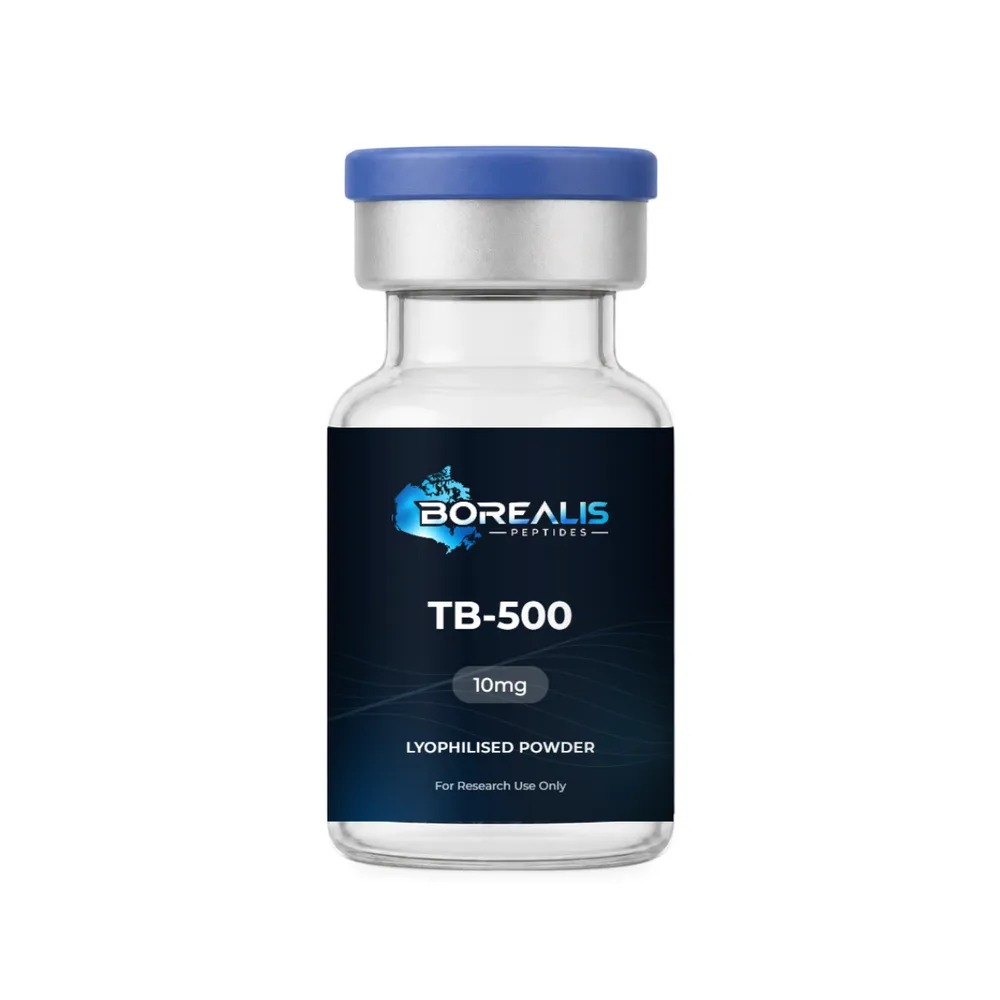
- Lyophilised powder supplied in 10 mg vials
- Sizes
- 10 mg
- Storage, dry
- −20 °C, dry and dark
- Storage, mixed
- 2–8 °C, use within 28 days of mixing (as generally reported for reconstituted peptides)
- BAC water per size
- 10 mg: 2 mL
What is TB-500?
In the literature TB-500 is characterised as a thymosin beta-4 related peptide (actin-binding). The published research runs across human and mouse work. The same material appears under more than one spelling, including TB500, TB 500 and thymosin beta-4. It is sold under the TB-500 name, while the research literature studies thymosin beta-4, a 43-amino-acid peptide. It has reached people in 3 studies, none of them controlled, so those outcomes cannot be separated from everything else that shifted alongside. We supply it as a lyophilised powder in 10 mg vials from Canadian stock, for laboratory research. It holds no medicinal authorization and is not for use in any living subject.
What the research shows
| Study | Model | Dose used | Duration | Finding |
|---|---|---|---|---|
| Drum CL et al.2017 · J Am Heart Assoc · PMID 28611096 | Human, observational biomarker study (HFpEF n=219, HFrEF n=219, controls n=219); circulating TB4 measured, none given | None given (the body's own plasma TB4 was measured) | Not stated in the abstract | Plasma TB4 was higher in HFpEF than in controls (1401 vs 985 ng/mL, P<0.001), an effect seen in women only. In women with heart failure, elevated TB4 carried a higher hazard ratio for all-cause death (1.668, P=0.036). |
| Sun YS et al.2025 · World J Gastroenterol · PMID 41278163 | Human colonic mucus (IBS patients); mouse and rat (Tβ4-deficient) models | Not stated in the abstract | Not stated in the abstract | Tβ4 treatment of mice reduced tight junction proteins in the gut lining, and Tβ4 released from mast cells under stress disrupted the intestinal epithelial barrier. Tβ4-deficient rats were resistant to stress-induced barrier disturbance. |
| Jin Z et al.2025 · Cell Signal · PMID 40912522 | Human breast cancer tissue and cell lines; mouse (in vivo) | Not stated in the abstract | Not stated in the abstract | Tβ4 was upregulated in breast cancer tissue, and high expression correlated with poor clinical outcomes. Tβ4 promoted cancer cell proliferation, migration and angiogenesis by regulating SLC7A11 and inhibiting ferroptosis. |
| Maar K et al.2025 · Int J Mol Sci · PMID 40362372 | Mouse, permanent coronary ligation (heart attack) model; human cardiac cells | Systemic TB4 injection; amount not stated in the abstract | Not stated in the abstract | TB4 raised miR139-5p expression and modulated ROCK1 protein levels in mouse hearts and human cardiac cells, and may reverse or inhibit fibroblast-to-myofibroblast transformation. |
| Li Y et al.2025 · J Allergy Clin Immunol · PMID 39978686 | Mouse, house dust mite allergic asthma model (BDCA2-DTR mice); cell experiments | Tβ4 supplementation; amount not stated in the abstract | Not stated in the abstract | Tβ4 supplementation reversed the worsened asthma phenotype in mice depleted of plasmacytoid dendritic cells. Tβ4 inhibited IL-4/IL-13-induced JAK1/STAT6 signalling and CCL2 expression in macrophages. Serum Tβ4 was lower in mice and humans with ongoing allergic asthma. |
| Li H et al.2018 · J Gene Med · PMID 29972714 | Mouse, CCl4-induced liver fibrosis model (gene delivery, not peptide); liver cells in vitro | Intraperitoneal adeno-associated virus encoding Tβ4 (AAV-Tβ4); amount not stated in the abstract | Not stated in the abstract | AAV-Tβ4 pre-treatment significantly reduced liver injury, collagen deposition, stellate cell activation and pro-fibrotic cytokines, partly by down-regulating TGF-β receptor II. |
| Bako P et al.2023 · Int Immunopharmacol · PMID 38706788 | Mouse tympanic membrane (eardrum) explants, ex vivo and on collagen gels | Not stated in the abstract | Not stated in the abstract | TB4 affected the migration and proliferation of epidermal and epithelial cells of the tympanic membrane in vitro, most likely acting on local epidermal progenitor cells. |
What these studies don't show: The human work here has no controls: pilot studies, case reports and retrospective reviews. Without a control arm there is no way to pin a change on the compound. These are brief studies in few people, which tells us nothing about continued use. Testing confirms identity and purity; it is not evidence of an effect.
Every study links to its PubMed record. See all TB-500 studies in the research library →
TB-500 price in Canada: 10mg vial
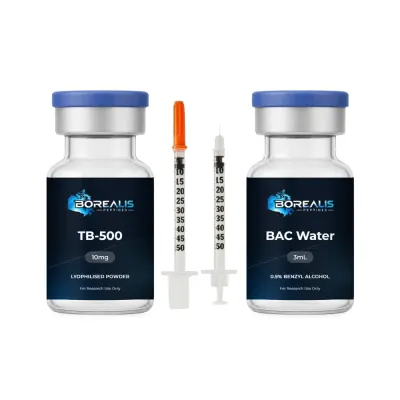
Buy TB-500 in Canada in a 10mg vial and a starter kit. Prices are in Canadian dollars, you pay by Interac e-Transfer or bank transfer, and orders are shipped from Canadian stock.
| Size | Price | Per mg |
|---|---|---|
| 10 mg | $62.00 | $6.20/mg |
Starter kit
Is TB-500 available in Canada?
No TB-500 product carries a Drug Identification Number in Canada. Its safety, efficacy and quality have never been assessed by a regulator here. For Borealis Peptides this is in-vitro research material only, never supplied for use in a living subject. How Health Canada treats research peptides →
Side effects reported in studies
A small study reporting no effect is not proof of safety. Every statement is pinned to the study that made it. Not one of the cited abstracts records a tolerability finding for TB-500.
TB-500 FAQ
What is TB-500?
In chemical terms TB-500 is classed as a thymosin beta-4 related peptide (actin-binding). The published research covers human and mouse work. Borealis Peptides offers it as a lyophilised powder in 10 mg vials for in-vitro laboratory research. It is no drug, nor is it supplied for use in a person or an animal. Each cited paper below appears with the system it used and what it turned up.
Where can I buy TB-500 in Canada?
Straight from Borealis Peptides, kept in Canadian stock so nothing has to clear a border to reach you. Held in 10 mg vials. Purity is verified by HPLC batch by batch, and we supply for laboratory research only. HPLC is run on each batch, and the certificate you receive points to the batch that was sent to you.
Is TB-500 legal in Canada?
No TB-500 product carries a Drug Identification Number in Canada. Its safety, efficacy and quality have never been assessed by a regulator here. Borealis Peptides holds it purely for in-vitro research and provides it for use in no living subject. Health Canada has stated that "Research Use Only" labelling does not make a product legal to use in a person, so we understand it as a label on the intended supply, not a green light for use.
How much TB-500 should I use?
Borealis Peptides provides no dosing, protocols or reconstitution volumes, and will not supply them if asked. In the lab the quantity is dictated by the study design, something a supplier cannot reasonably set. The figures shown here are what particular published studies used within their own models: a record of past work, not a recommendation.
What human evidence is there for TB-500?
Human work exists, but none of it is controlled. 3 studies involved people, in the form of pilots, case reports or retrospective reviews. Absent a control group, none can prove the compound caused what was seen, and the page states as much next to the table.
How is TB-500 stored?
The sealed vial is stored at −20 °C, away from light and moisture. Solutions are kept at 2–8 °C. As a dry powder it travels at room temperature and is chilled when it arrives. What wears down a lyophilised peptide is light and temperature cycling, not time in transit.
How is the purity of TB-500 confirmed?
HPLC tests each batch before it is sold, and the certificate points to the batch in your vial rather than to the product at large. Filing that batch number with your records is what lets an observation be reproduced later. Certificates are available on request.
How does TB-500 compare with BPC-157 and Wolverine blend (BPC-157 + TB-500)?
Each carries its own published record, and comparing them comes down to reading both. BPC-157 and Wolverine blend (BPC-157 + TB-500) have 7 cited studies and 8 cited studies on their page against 7 here. Reading both tables, with the models each one used, is the comparison worth making.
Why is TB-500 named in a Health Canada advisory?
Because it was one of the peptides seized from sellers putting unauthorized injectable products online. The advisory addresses material sold for people to inject without authorization. Borealis Peptides keeps to research material for laboratory use and sells nothing for injection or for any use in a person, so it sits squarely where the advisory draws its line.
Compare with
Related compounds
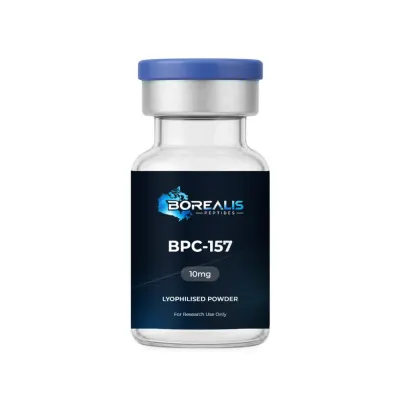
BPC-157
Synthetic pentadecapeptide derived from a gastric protein
Add 2 more to save 4%
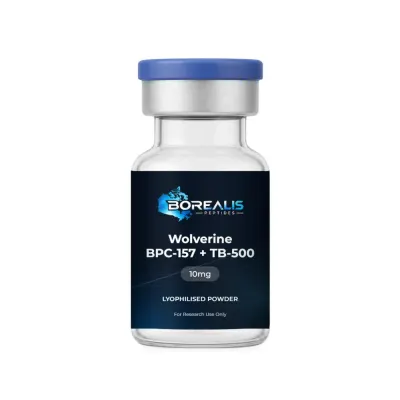
Wolverine blend (BPC-157 + TB-500)
Two-peptide research blend: a gastric pentadecapeptide and a thymosin beta-4 related peptide
Add 2 more to save 4%
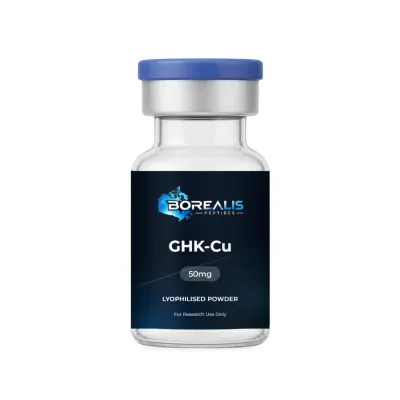
GHK-Cu
Copper-binding tripeptide (Gly-His-Lys copper complex)
Add 2 more to save 4%