- Also known as
- GHK Cu · copper peptide · copper tripeptide-1 · glycyl-L-histidyl-L-lysine copper(II)
- Class
- Copper-binding tripeptide, the Gly-His-Lys copper complex
- Form
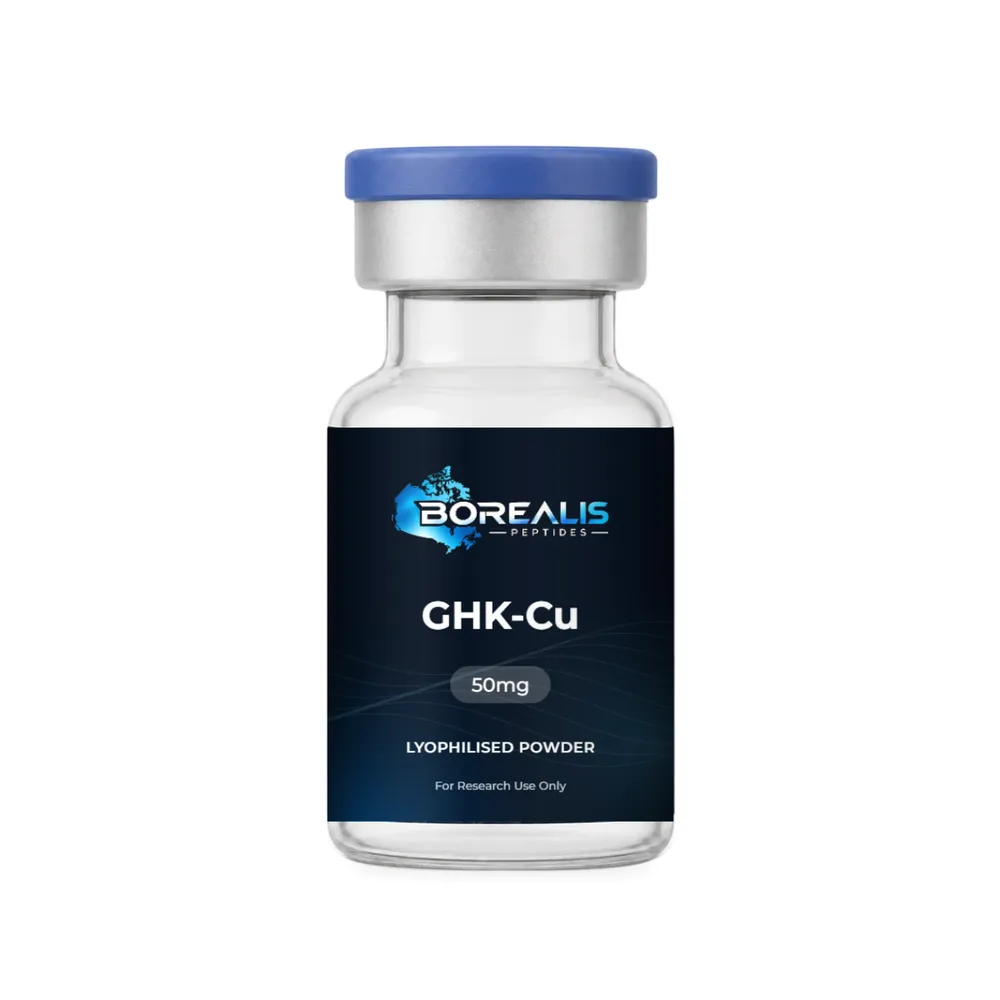
- Lyophilised powder supplied in 50 mg and 100 mg vials
- Sizes
- 50 mg · 100 mg
- Storage, dry
- −20 °C, dry and dark
- Storage, mixed
- 2–8 °C, use within 28 days of mixing (as generally reported for reconstituted peptides)
- BAC water per size
- 50 mg: 5 mL · 100 mg: 5 mL
What is GHK-Cu?
Both suppliers and the literature describe GHK-Cu as a copper-binding tripeptide (Gly-His-Lys copper complex). The published research covers rat, human, mouse and cell-culture work. Across the literature the same substance turns up under several spellings, among them GHK Cu, copper peptide and copper tripeptide-1. The recorded sequence is Gly-His-Lys (GHK) complexed with a copper(II) ion. One of the 8 studies listed below is a controlled trial in people. Borealis Peptides offers it as a lyophilised powder in 50 mg and 100 mg vials for in-vitro laboratory research. It holds no medicinal authorization and is not for use in any living subject.
What the research shows
| Study | Model | Dose used | Duration | Finding |
|---|---|---|---|---|
| Miller TR et al.2006 · Arch Facial Plast Surg · PMID 16847171 | Human, randomised controlled trial (n=13 completed), skin after CO2 laser resurfacing | Topical skin care products with or without GHK-Cu; concentration not stated in the abstract | 12 weeks | Computer analysis and blinded evaluators found no significant difference between groups in erythema, wrinkles or overall skin quality. On the patient questionnaire, rated improvement in overall skin quality was higher in the GHK-Cu group (P = .04). |
| Li H et al.2015 · Pharm Res · PMID 25690343 | Human skin in vitro, cell culture and pig (porcine) model; microneedle delivery | Not stated in the abstract | 9 hours (skin permeation test) | After microneedle pre-treatment, 134 ± 12 nanomoles of peptide and 705 ± 84 nanomoles of copper passed through human skin in 9 h, against almost none through intact skin. No obvious signs of skin irritation were observed. |
| Deng M et al.2023 · J Cachexia Sarcopenia Muscle · PMID 36905132 | Mouse (C57BL/6), cigarette-smoke muscle dysfunction model; C2C12 muscle cells; plasma GHK measured in people with COPD (n=9) and healthy controls (n=11) | 0.2 and 2 mg/kg (route not stated in the abstract) | Not stated in the abstract | GHK-Cu reduced smoke-induced loss of muscle mass and improved grip strength (175.5 g untreated vs 257.6 g and 339.1 g). Plasma GHK was lower in the COPD group than in controls (70.27 vs 133.0 ng/mL). |
| Zhang Q et al.2023 · Biomed Pharmacother · PMID 37257226 | Mouse, ovalbumin-induced asthma model; airway epithelial cells; plasma GHK measured in asthma patients | Not stated in the abstract | Not stated in the abstract | GHK-Cu reduced peribronchial collagen deposition, airway mucus secretion and epithelial-mesenchymal transition, linked to lower TGF-β1 through SIRT1. Plasma GHK was lower in asthma patients than in age-matched controls. |
| Bian Y et al.2024 · Redox Biol · PMID 38879894 | Mouse, crystalline silica (silicosis) model; RAW264.7 macrophage cells | Not stated in the abstract | Not stated in the abstract | GHK-Cu bound peroxiredoxin 6 and reduced lung inflammation and fibrosis in silicosis mice without significant systemic toxicity, partly by limiting oxidative stress in alveolar macrophages. |
| Wang X et al.2017 · Wound Repair Regen · PMID 28370978 | Mouse, scald burn model; human umbilical vein endothelial cells (HUVECs) | GHK-Cu in liposomes; amount not stated in the abstract | Wound healing time 14 days post injury in the liposome group | GHK-Cu liposomes raised HUVEC proliferation by 33.1% and gave better angiogenesis in burned skin than free GHK-Cu, with wound healing time shortened to 14 days. |
| Synytsya A et al.2020 · Int J Biol Macromol · PMID 33031852 | Rat, experimental cutting wound model (tripeptide GHK in hydrogels; copper not stated in the abstract) | Not stated in the abstract | Not stated in the abstract | GHK in pectin or flaxseed gum hydrogels gave a significantly higher healing degree and shorter healing time than untreated controls or GHK in aqueous solution. Complete histological healing was seen only with the flaxseed gum hydrogel. |
| Pollard JD et al.2005 · Arch Facial Plast Surg · PMID 15655171 | Cell culture (normal and irradiated human dermal fibroblasts) | 1 × 10⁻⁹ mol/L | Not stated in the abstract | GHK-Cu shortened the population-doubling time of normal and irradiated fibroblasts. Treated irradiated fibroblasts produced significantly more basic FGF and VEGF than untreated controls early after exposure. |
What these studies don't show: Controlled trials do exist, though the questions they settle are narrow. The enrolment, the measures chosen and the length of follow-up each bound what the results can mean. The findings apply to the setting studied and no further. Purity data verifies what is in the vial and says nothing about whether a compound works.
Every study links to its PubMed record. See all GHK-Cu studies in the research library →
GHK-Cu price in Canada: 50mg and 100mg vials
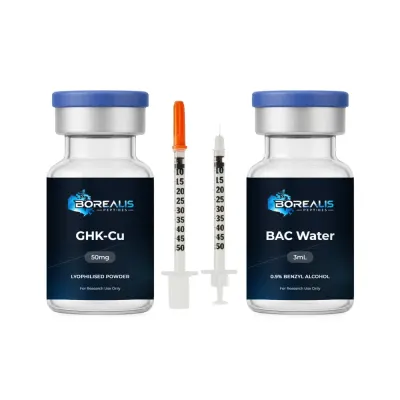
Buy GHK-Cu in Canada in 2 vial sizes and a starter kit. Prices are in Canadian dollars, you pay by Interac e-Transfer or bank transfer, and orders are shipped from Canadian stock.
| Size | Price | Per mg |
|---|---|---|
| 50 mg | $43.50 | $0.87/mg |
| 100 mg | $62.00 | $0.62/mg |
Starter kit
Is GHK-Cu available in Canada?
GHK-Cu is absent from the Drug Product Database as an authorized product. Health Canada has run no safety, efficacy or quality review of it. It is held by Borealis Peptides for in-vitro research and supplied for use in no living subject. Read more →
Side effects reported in studies
A small study reporting no effect is not proof of safety. Every statement is pinned to the study that made it. Not one of the cited abstracts records a tolerability finding for GHK-Cu. Read more →
Doses used in studies
GHK-Cu FAQ
What is GHK-Cu?
GHK-Cu is a copper-binding tripeptide (Gly-His-Lys copper complex). The published research covers rat, human, mouse and cell-culture work. Borealis Peptides offers it as a lyophilised powder in 50 mg and 100 mg vials for in-vitro laboratory research. It holds no medicinal authorization and is not for use in any living subject. Each study on this page carries its model and the outcome its authors set down.
Where can I buy GHK-Cu in Canada?
Borealis Peptides sends GHK-Cu out of Canadian stock to research and business addresses within Canada. It comes in 50 mg and 100 mg vials. HPLC tests every batch, and the certificate names the batch in your vial. Orders are taken for laboratory research only.
Is GHK-Cu legal in Canada?
GHK-Cu is absent from the Drug Product Database as an authorized product. Health Canada has run no safety, efficacy or quality review of it. Borealis Peptides holds it for in-vitro research alone and supplies it for use in no living subject. Health Canada has stated that "Research Use Only" labelling does not make a product legal to use in a person, so to us it names what the material is for and grants no permission to use it. Establishing lawful use within your own setting falls to you.
How much GHK-Cu should I use?
We take no dosing questions. GHK-Cu is not supplied for use in a person or an animal, so there is no dose to set out. What this page carries is the amount each cited study used and the model it used it in, reproduced as the authors published it.
What human evidence is there for GHK-Cu?
Of the 8 studies cited, one is a controlled trial in people and the others are animal or cell work. Each row names its model, the amount used and what the authors reported, so the weight of each study can be judged directly rather than through a summary.
How long does GHK-Cu keep?
Unopened, hold it at −20 °C in the dark. Solutions are kept at 2–8 °C. Ambient transit leaves the dry powder unharmed; refrigerate it once it is received. Keeping it dark and at a steady temperature counts for more than how quickly it arrived.
How is the purity of GHK-Cu confirmed?
HPLC tests each batch before it is sold, and the certificate points to the batch in your vial rather than to the product at large. Filing that batch number with your records is what lets an observation be reproduced later. Certificates are available on request.
How does GHK-Cu compare with GLOW blend and KLOW?
Each carries its own published record, and comparing them comes down to reading both. GLOW blend and KLOW have 8 cited studies and 8 cited studies on their page against 8 here. The comparison worth making is between the two study tables and the models that sit behind them.
Why is GHK-Cu named in a Health Canada advisory?
Because it was one of the peptides seized from sellers putting unauthorized injectable products online. The advisory addresses material sold for people to inject without authorization. What Borealis Peptides sells is research material for the laboratory bench, never anything for injection or for any use in a person, and that distinction is the one the advisory turns on.
Compare with
Related compounds
GLOW blend
Three-peptide research blend: a copper tripeptide, a gastric pentadecapeptide and a thymosin beta-4 related peptide
Add 2 more to save 4%
KLOW
Four-peptide research blend (GHK-Cu, BPC-157, TB-500, KPV)
Add 2 more to save 4%
BPC-157
Synthetic pentadecapeptide derived from a gastric protein
Add 2 more to save 4%