- Also known as
- Elamipretide · Bendavia · MTP-131 · SS31 · Szeto-Schiller peptide 31
- Class
- Mitochondria-targeting tetrapeptide (cardiolipin binder)
- Form
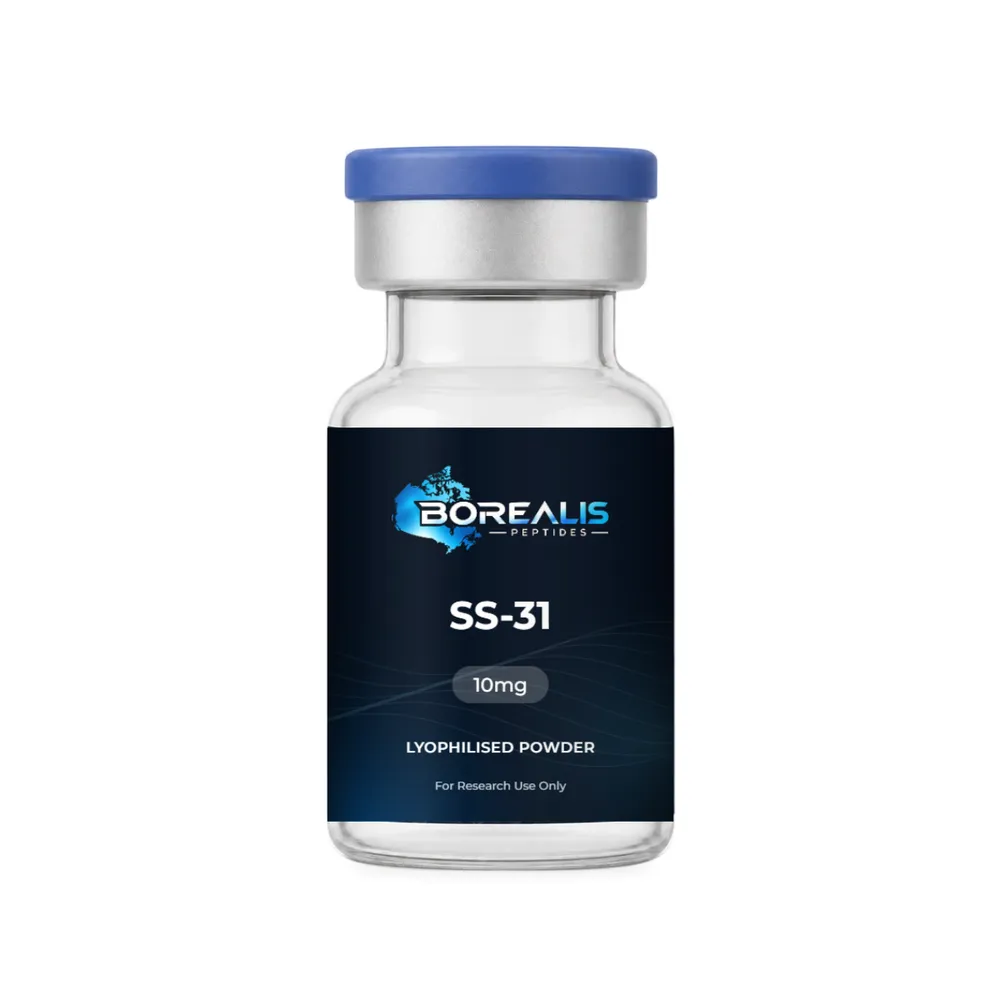
- Powder, lyophilised, in 10 mg vials
- Sizes
- 10 mg
- Storage, dry
- −20 °C, dry and dark
- Storage, mixed
- 2–8 °C, use within 28 days of mixing (as generally reported for reconstituted peptides)
- BAC water per size
- 10 mg: 2 mL
- Molecular weight
- 639.8 g/mol (C32H49N9O5)
What is SS-31?
By chemistry SS-31 falls under mitochondria-targeting tetrapeptide (cardiolipin binder), with a molecular weight of 639.8 g/mol (C32H49N9O5). Several spellings in the literature point to the same material, among them Elamipretide, Bendavia and MTP-131. Its recorded sequence is D-Arg-Dmt-Lys-Phe-NH2, in which Dmt is 2′,6′-dimethyltyrosine. Research published on it covers human and mouse, and 3 of the 7 studies set out below are controlled human trials. The literature also refers to it as Elamipretide, Bendavia and MTP-131. Kept in Canadian stock as lyophilised powder in 10 mg vials, for laboratory research. It is not a drug and is not supplied for use in a person or an animal.
What the research shows
| Study | Model | Dose used | Duration | Finding |
|---|---|---|---|---|
| Karaa A et al.2023 · Neurology · PMID 37268435 | Human, phase 3 randomised double-blind placebo-controlled trial, primary mitochondrial myopathy (n=218) | 40 mg/day subcutaneous | 24 weeks | The trial did not meet its primary endpoints: the difference from placebo was -3.2 m on the 6-minute walk test (p = 0.69) and -0.07 on total fatigue (p = 0.37). Elamipretide was well tolerated, with most adverse events mild to moderate. |
| Karaa A et al.2024 · Orphanet J Rare Dis · PMID 39574155 | Human, post hoc analysis of the MMPOWER-3 randomised trial by genotype | Not stated in the abstract (MMPOWER-3 treatment arms) | 24 weeks | Patients with mtDNA replisome variants improved 25.2 m on the 6-minute walk test versus 2.0 m on placebo (p = 0.06). Within that group, those with CPEO improved 37.3 m versus -8.0 m (p = 0.0024). |
| Thompson WR et al.2024 · Genet Med · PMID 38602181 | Human, open-label extension of the TAZPOWER randomised trial, Barth syndrome (n=10 entered, 8 reached week 168) | 40 mg subcutaneous daily | 168-week open-label extension after a 28-week randomised phase | The 6-minute walk test improved at every time point, by a cumulative 96.1 m at week 168 (P = .003), and fatigue scores stayed below baseline. Injection-site reactions were the most common adverse events. |
| Hornby B et al.2022 · Orphanet J Rare Dis · PMID 36056411 | Human, retrospective natural history comparison, Barth syndrome (8 treated patients vs 19 untreated controls) | 40 mg daily | Compared at weeks 64 and 76 | The 6-minute walk test favoured elamipretide by 79.7 m at week 64 and 91.0 m at week 76, with gains in handheld muscle strength. Left ventricular stroke volume rose in treated patients and fell in the untreated controls. |
| Vieira Neto E et al.2026 · J Inherit Metab Dis · PMID 41500837 | Mouse, βTFP-deficient (mitochondrial trifunctional protein deficiency); patient-derived fibroblasts | Delivered by osmotic minipump; amount not stated in the abstract | Not stated in the abstract | Treated βTFP-deficient mice showed better exercise endurance but no change in cold tolerance, and liver mitochondria had improved FAO-ETC enzyme activity. Cardiolipin content and composition did not change. |
| Xie M et al.2026 · Lung · PMID 41801306 | Mouse, ozone-induced airway injury (C57BL/6J); BEAS-2B airway cells | Intraperitoneal, 1 h before ozone exposure; amount not stated in the abstract | Single ozone exposure | SS-31 and N-acetylcysteine comparably reduced airway hyperresponsiveness, inflammatory cell influx and mucus hypersecretion. Both lowered ROS and malondialdehyde and improved SOD activity and GSH/GSSG. |
| Tse BC et al.2020 · Exp Eye Res · PMID 32758490 | Mouse, sonication-induced traumatic optic neuropathy | Intravitreal and/or subcutaneous MTP-131; amount not stated in the abstract | Not stated in the abstract | Subcutaneous MTP-131 alone raised retinal ganglion cell survival by 17% over controls (p < 0.01). Combining it with etanercept gave no synergistic effect. |
What these studies don't show: The controlled evidence is genuine but tied to a particular setting. Participants are screened, many endpoints stand in as proxies, and most trials finish early. None of it applies beyond the trial protocol itself. Confirming that the vial contains what the label states tells you nothing about what the compound actually does.
Every study links to its PubMed record. See all SS-31 studies in the research library →
SS-31 price in Canada: 10mg vial
Buy SS-31 in Canada in a 10mg vial and a starter kit. Prices are in Canadian dollars, you pay by Interac e-Transfer or bank transfer, and orders are shipped from Canadian stock.
| Size | Price | Per mg |
|---|---|---|
| 10 mg | $70.50 | $7.05/mg |
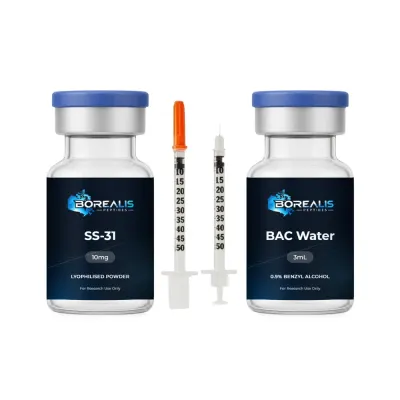
Starter kit
Is SS-31 available in Canada?
SS-31 holds no Drug Identification Number, the mark Health Canada places on a drug it has authorized. Health Canada has given it no safety, efficacy or quality review. We carry it as research material for laboratory work alone, not for any use in a person or an animal. How Health Canada treats research peptides →
Side effects reported in studies
Whatever the cited studies observed about tolerability is reproduced here word for word. Human research on this scale cannot establish a safety profile.
SS-31 FAQ
What is SS-31?
In the literature SS-31 is categorised as a mitochondria-targeting tetrapeptide (cardiolipin binder). Research on it covers human and mouse. Borealis Peptides keeps it as lyophilised powder in 10 mg vials for in-vitro laboratory research. It is not a drug and is not supplied for use in a person or an animal. Each cited paper below is shown with the system it ran in and what it found.
Where can I buy SS-31 in Canada?
It is dispatched within Canada from the stock we hold, in 10 mg vials. Nothing goes out until HPLC has confirmed identity and purity for that batch. Borealis Peptides takes research orders only and ships to research and business addresses. Each batch has its own HPLC analysis, tied to the number printed on the vial.
Is SS-31 legal in Canada?
SS-31 holds no Drug Identification Number, the mark Health Canada places on a drug it has authorized. Health Canada has given it no safety, efficacy or quality review. It is kept strictly as laboratory research material, never for use in a person or an animal. Because Health Canada has stated that "Research Use Only" labelling does not make a product legal to use in a person, we take it to set out what the material is supplied for, not a licence to use it.
How much SS-31 should I use?
We do not field dosing questions. SS-31 is not supplied for use in a person or an animal, so there is no dose to describe. What this page carries is the quantity each cited study used and the model it was used in, reproduced as the authors published it.
What human evidence is there for SS-31?
Among the 7 cited studies, 3 are controlled human trials and the remainder are animal or cell work. Every row states its model, the quantity used and what the authors reported, letting each study be weighed directly rather than via a summary.
How long does SS-31 keep?
Hold sealed vials at −20 °C, dry and dark. In solution it is kept at 2–8 °C. As a dry powder it travels at room temperature and goes cold on arrival. Keeping it dark and at a steady temperature counts for more than how quickly it arrived.
How is the purity of SS-31 confirmed?
HPLC testing is done on every batch before sale, and the certificate points to the batch in your vial rather than to the product in general. Filing that batch number with your records is what lets an observation be reproduced later. Certificates can be requested at any time.
How does SS-31 compare with MOTS-C and NAD+?
They are not interchangeable, and this page makes no claim that one is preferable. MOTS-C and NAD+ carry 7 cited studies and 8 cited studies on their page against 7 here. Place the two evidence tables side by side and the difference shows itself directly.
Why is SS-31 named in a Health Canada advisory?
Because it was among the peptides seized from sellers offering unauthorized injectable products online. The advisory deals with material sold for people to inject without authorization. Borealis Peptides deals only in research material for in-vitro work and puts up nothing for injection or for any use in a person, placing it on the safe side of the line the advisory draws.
Compare with
Related compounds
SLU-PP-332
Synthetic pan-ERR (ERRα/β/γ) agonist, small molecule
Add 2 more to save 4%